

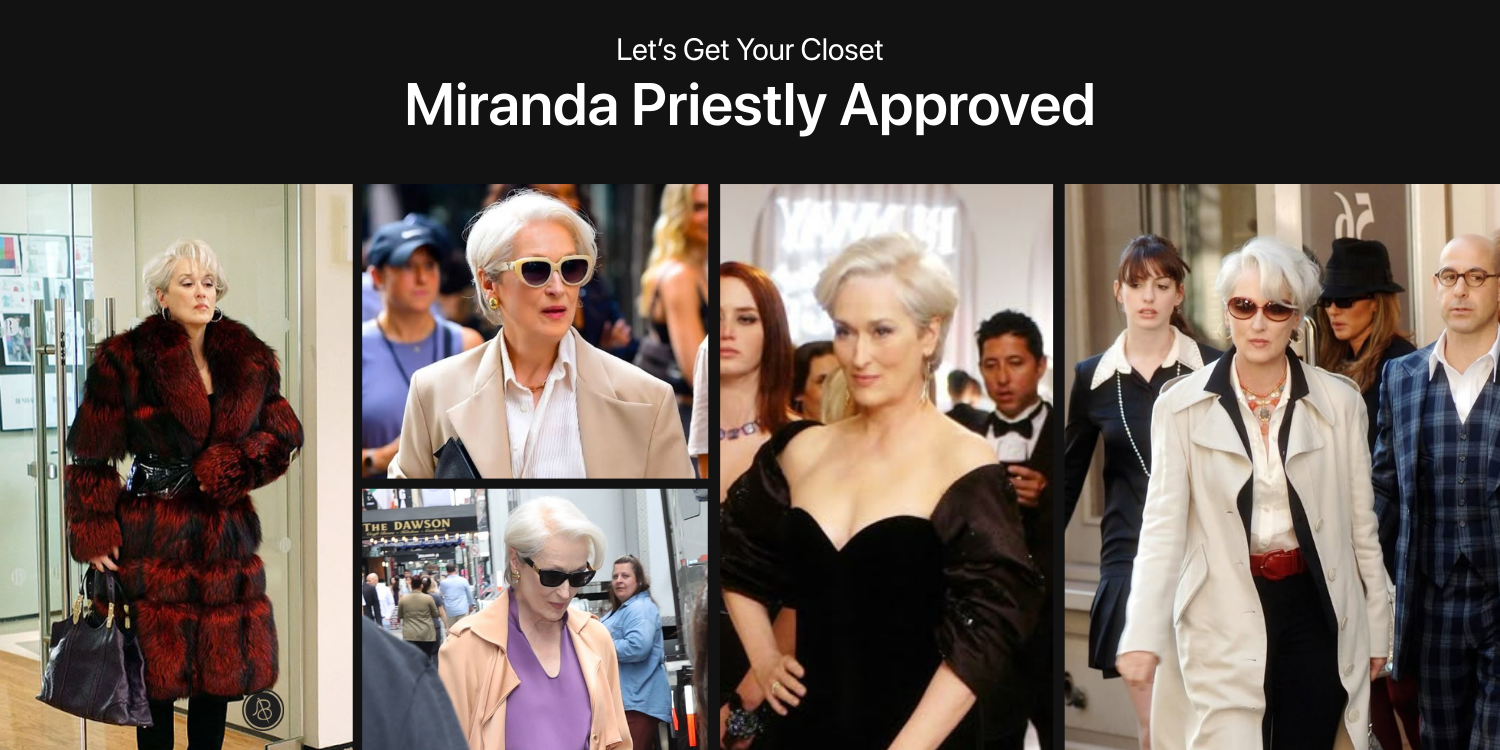
The year is 2006. A heel strikes the pavement of New York City, and the cinematic world holds its breath. Miranda Priestly has arrived.
Fast forward nearly two decades, and the editor-in-chief of Runway magazine is back in the cultural conversation. The Devil Wears Prada is experiencing a renaissance, capturing the imagination of a new generation on TikTok and Instagram. But why? Is it the sharp wit? The terrifying stares? The drama of the magazine industry? Perhaps. But if we look closer, the enduring obsession isn't really about Miranda the villain. It is about Miranda the icon. Specifically, it is about her clothes.
In an era defined by "core" aesthetics that change weekly—cottagecore, mob wife aesthetic, ecletic grandpa—Miranda Priestly stands as a monolith of consistency. Her wardrobe is the ultimate benchmark for power dressing. But unlike the power dressing of the 80s, which relied on shoulder pads wide enough to clear a doorway, Miranda’s power comes from something far more dangerous: absolute intention.
Getting your wardrobe "Miranda Priestly Approved" isn't about buying a specific brand or spending a year's salary on a coat. It is about adopting a philosophy. It is about understanding that clothing is language, and if you aren't speaking clearly, you might as well be silent.
This deep dive explores how a fictional character became a very real style muse for the modern, intentional dresser. We will decode the sunglasses, the coats, and the color theory to understand how you can build a wardrobe that doesn't just look good, but commands respect.

The Philosophy of Intention: Why She Still Matters
To understand Miranda’s style, you have to understand her mind. She is a woman who does not waste time. She does not explain herself. She does not apologize. Her wardrobe is an extension of this efficiency.
Most people dress based on how they feel in the moment, or worse, based on what they think others want to see. This leads to a closet full of confusion—items that don't match, fits that are "good enough," and trends that expire faster than milk. Miranda dresses with a singular purpose: to communicate authority, restraint, and clarity.
For the modern fashion enthusiast—especially Gen Z and Millennials navigating a chaotic digital world—this kind of clarity is intoxicating. We are drowning in options. Fast fashion sites upload thousands of new styles daily. Influencers tell us we need everything. Miranda represents the antithesis of this churn. She represents the "buy less, choose well" ethos before sustainability became a buzzword.
Her style endures because it is built on architecture, not decoration. Every piece she wears has a job to do. There is no fluff. There is no uncertainty. When she walks into a room, the clothes tell you exactly where you stand (usually, terrified). But stripped of the villainy, that level of self-assurance is the ultimate style goal. It’s about curating a wardrobe where every single item pulls its weight. It’s about the luxury of knowing exactly who you are.

The Sunglasses: A Tool for Boundary Setting
Let’s start with the accessories. Or rather, the singular accessory that defines her entrance: the sunglasses.
Miranda’s sunglasses are not just sun protection. They are a boundary. They are a physical manifestation of the emotional distance she keeps from the rest of the world. In the language of styling, accessories often serve as "conversation starters." For Miranda, they are conversation enders.
The sunglasses she wears—often slightly oversized, dark, and impeccably shaped—signal that she is observing you, but you are not permitted to observe her. It creates an imbalance of power before a word is spoken. This is a crucial lesson for modern dressing. Accessories shouldn't just be things you pile on because an outfit feels empty. They should serve a function in your narrative.
Think about how you use accessories in your own life. Do you wear jewelry that jingles and distracts? Do you carry a bag that is overflowing and messy? Or do you choose pieces that sharpen your silhouette?
Getting your accessory game Miranda-approved means treating your sunglasses, your bags, and your jewelry as armor. It means choosing items that are pristine and deliberate. It’s the difference between wearing sunglasses because it’s bright out, and wearing sunglasses because you are in control of your environment. It signals that you are focused, unbothered, and entirely self-contained. It is a "do not disturb" sign written in acetate and gold.
The Black Dress Philosophy: Removing the Noise
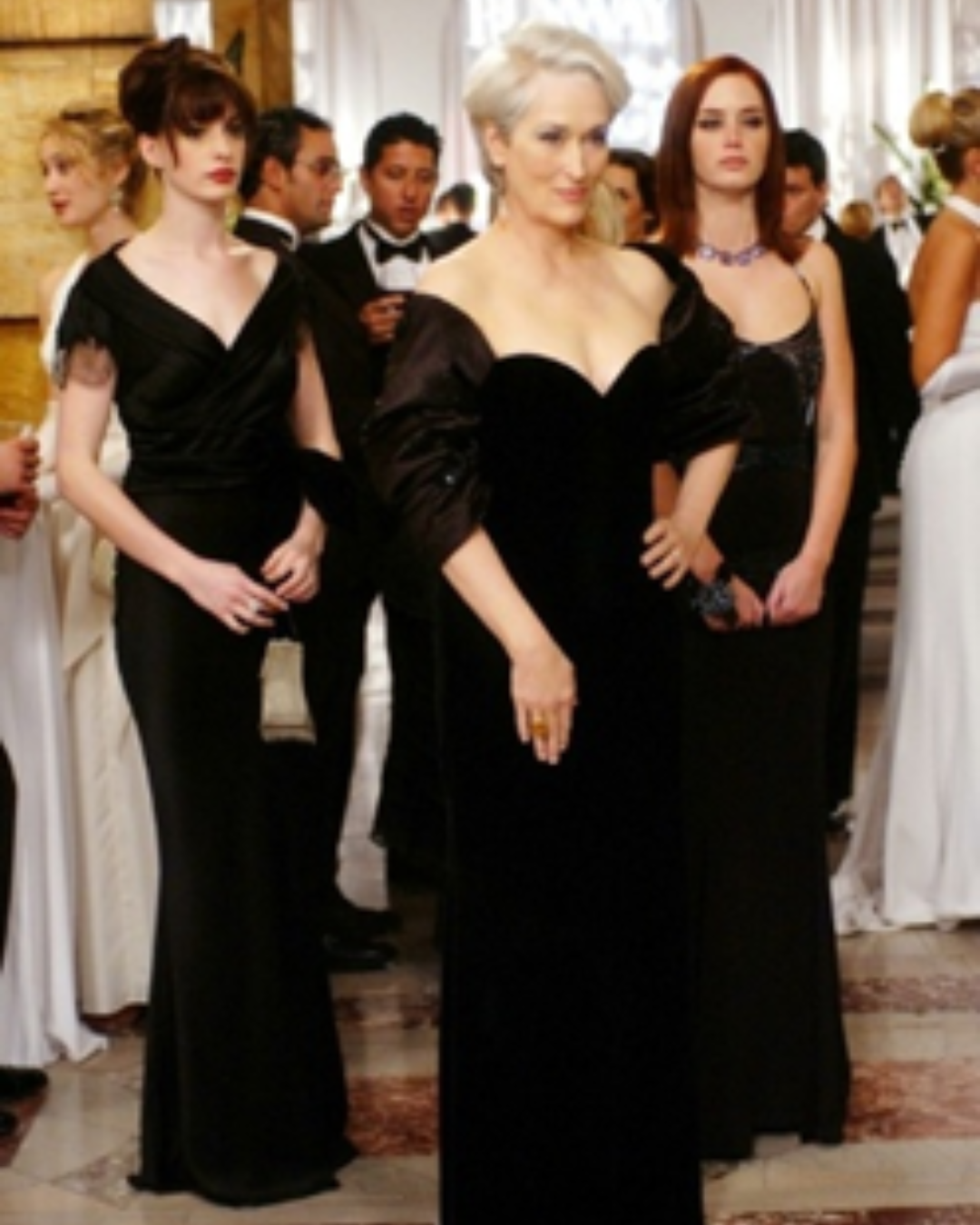
If you scroll through the archives of Miranda’s looks, you will notice a recurring theme: the black dress. But these aren't just any black dresses. They are masterclasses in silhouette.
The "Little Black Dress" is a cliché. The "Miranda Black Dress" is a strategy.
Why does black work so well for authority? Because it removes the noise. When you wear a pattern, the eye dances around. It looks for the repeat; it analyzes the color. When you wear impeccable black, the eye has nowhere to go but to the cut of the fabric and the face of the wearer. It forces the viewer to engage with the person, not the print.
Miranda’s black dresses are never boring because they rely on texture and tailoring. A deep V-neck that elongates the torso. A cinched waist that defines the structure. A fabric that absorbs light rather than reflecting it. This approach shows that simplicity, when executed correctly, carries more weight than complexity.
For the modern wardrobe, this is a call to return to basics—but high-quality basics. We often confuse "style" with "novelty." We think we need the neon, the ruffles, the cut-outs to be stylish. Miranda proves that a perfectly fitted black sheath dress is infinitely more powerful.
This aligns perfectly with the current shift towards capsule wardrobes and minimalist aesthetics. It’s eco-chic in its purest form. By investing in one incredible black dress rather than five trendy ones, you reduce waste and increase your style equity. You stop worrying about whether you match the theme of the party, because you are the theme. You are the standard.
The Red Coat Moment: Dominance Through Saturation
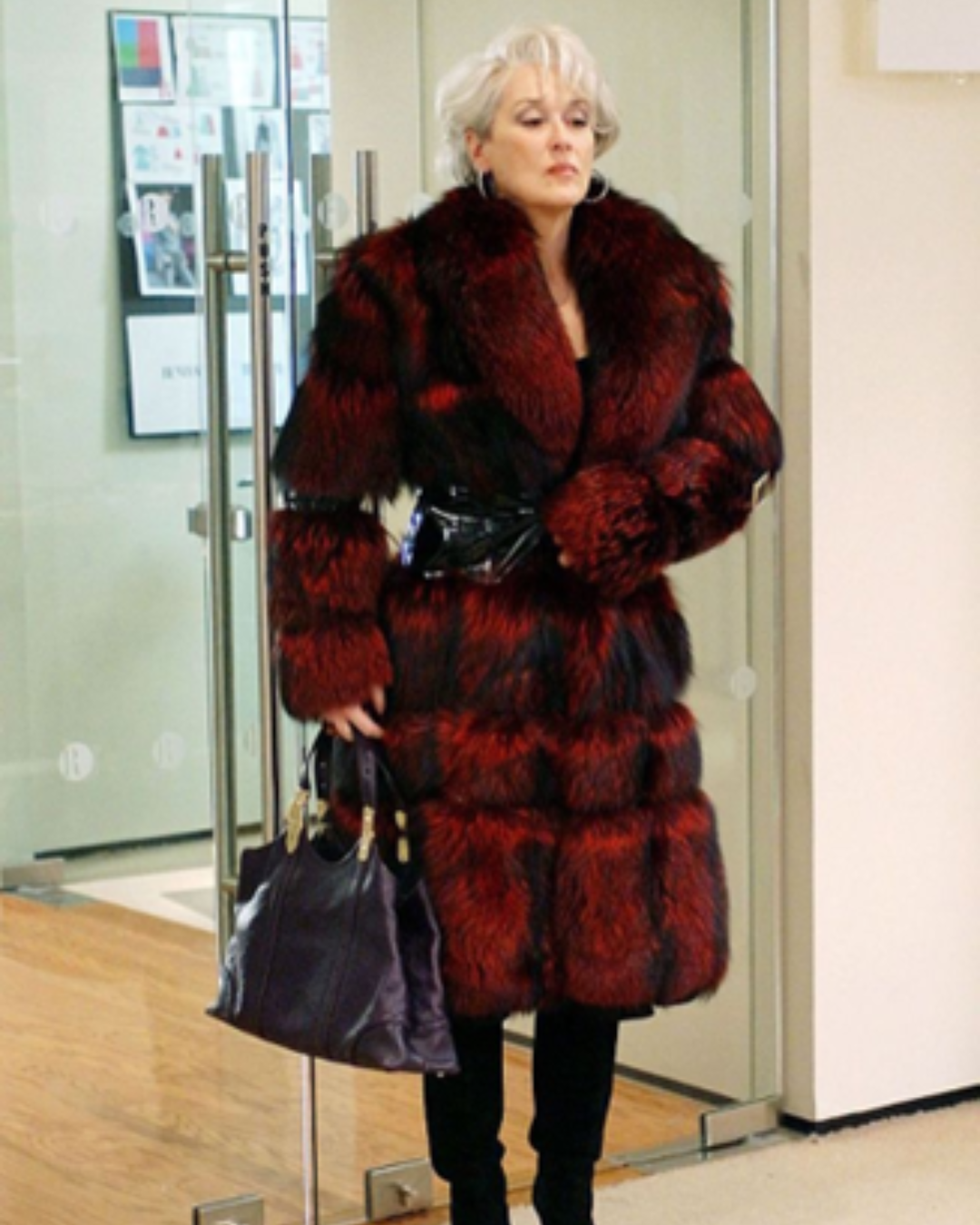
While Miranda is a master of neutrals, she is not afraid of color. But she uses color like a weapon. The red coat is the prime example.
You know the look. The fur trim. The deep, saturated crimson. It is a moment of pure dominance. In color psychology, red is the color of passion, danger, and urgency. It physically raises the heart rate of the viewer.
Most people wear red tentatively. They wear a red lip with a shy outfit, or a red shoe with jeans. Miranda wears red as a total commitment. The coat takes up space. It demands that you look at it.
This teaches us a vital lesson about "statement pieces." A true statement piece doesn't beg for attention; it commands it. The key to the red coat look is that the rest of the styling is restrained. She isn't wearing the red coat with green pants and yellow shoes. She lets the color do the heavy lifting.
To get your wardrobe approved, look at how you use color. Are you using it apologetically? Or are you using it decisively?
Power dressing involves identifying the colors that make you feel invincible and wearing them in substantial, architectural ways. It’s not about a pop of color. It’s about a block of power. Whether it’s a deep emerald, a navy blue, or that iconic red, the saturation should be rich and the fabric should hold the dye perfectly. Faded colors communicate neglect. Saturated colors communicate care and investment.
The Purple Look: Controlled Vibrancy
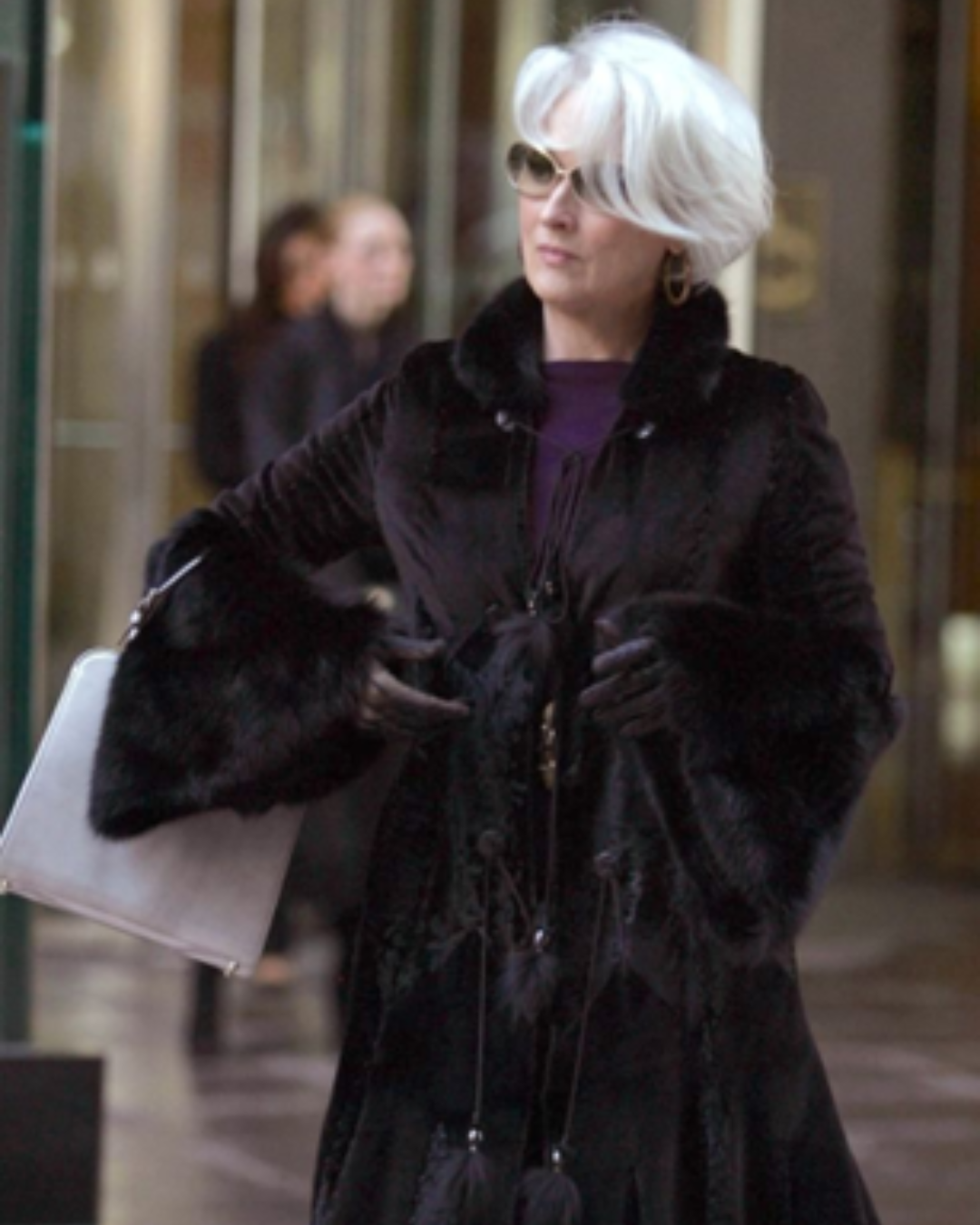
Another pivotal color moment is the purple dress layered with the dark coat. Purple has historically been the color of royalty, and Miranda wears it as such.
What makes this look interesting is the layering. She pairs a vibrant, jewel-toned dress with a structured, dark outer layer. This grounds the color. It stops the outfit from looking like a costume. It balances the "funky" element of the purple with the "serious" element of the coat.
This is a styling hack that Gen Z fashion enthusiasts can steal immediately. If you want to wear something bold—a bright slip dress, a neon top—anchor it with severe tailoring. Throw an oversized blazer over it. Wear it with a heavy trench.
Miranda’s use of purple demonstrates that you don't have to sacrifice personality to be taken seriously. You just have to frame your personality within a structure of authority. It is controlled vibrancy. It says, "I am creative, but I am also the boss."
This balance is what keeps her style from feeling stuffy. She isn't wearing a gray suit every day. She is playing with fashion, but she is playing by her own rules. She understands that color can be serious if the silhouette is sharp enough.
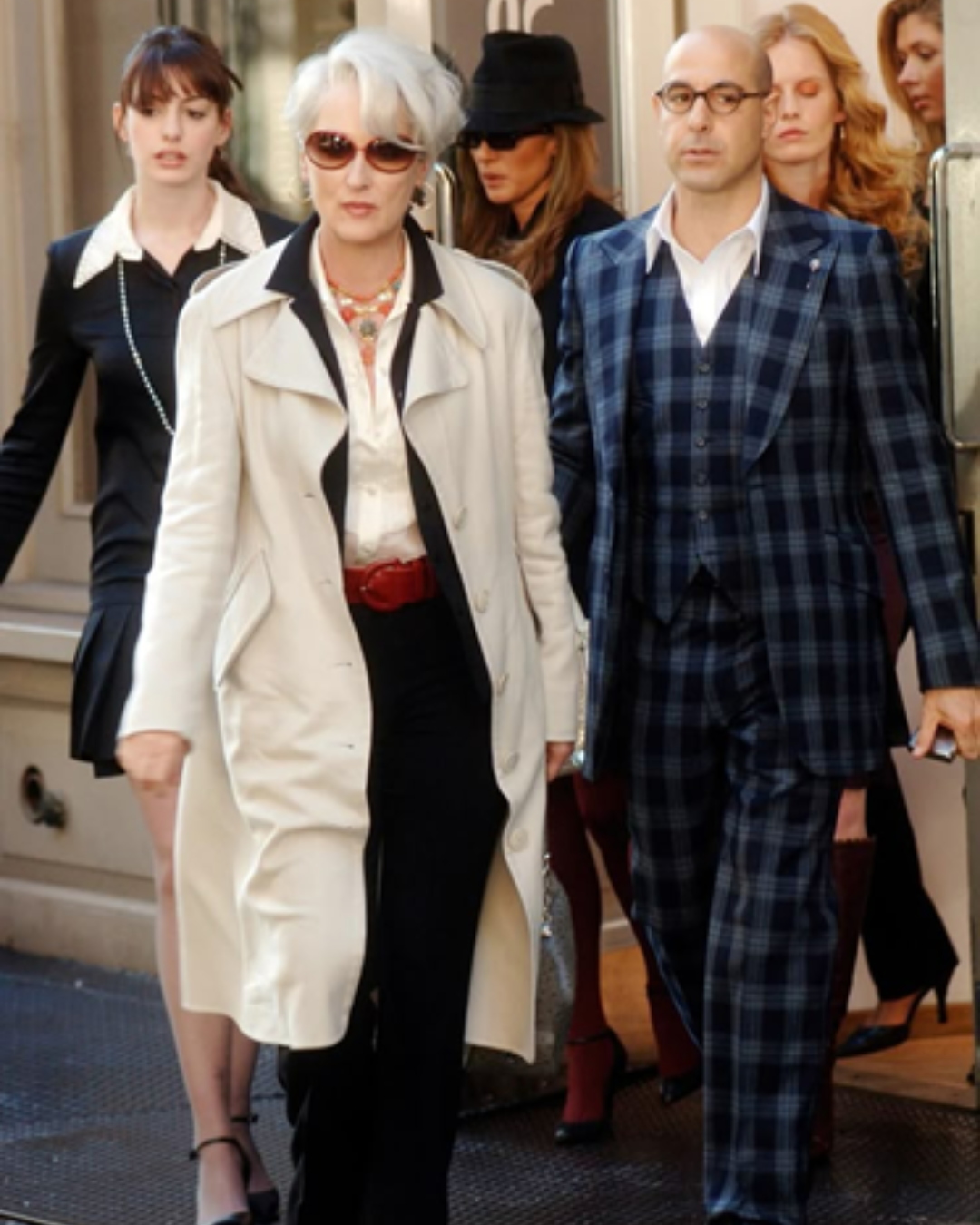
Authority in White: The Snow Queen Energy
Perhaps the most subversive of all her looks is the white coat.
In a city known for grime and grit, wearing white is the ultimate flex. It implies that you do not take the subway. It implies that you do not spill coffee. It implies that your world is clean, pristine, and untouched by the messiness of everyday life.
Miranda’s white look challenges the assumption that power must always appear dark, heavy, or severe. We often associate authority with navy, black, and charcoal. But the white look balances softness with absolute precision. It shows that confidence can be quiet.
The texture plays a huge role here. The softness of the wool or cashmere against the sharpness of her hair creates a visual tension that is incredibly chic. It is the "Snow Queen" energy—cold, beautiful, and untouchable.
For your own wardrobe, incorporating white or cream tailored pieces is a way to elevate your style instantly. A cream trouser or a white structured blazer looks expensive, regardless of the price tag. It reflects light onto the face. It stands out in a sea of black coats.
However, the "Miranda" rule applies strictly here: it must be pristine. There is no room for error with white. A stain, a wrinkle, or a scuff ruins the illusion. This level of maintenance is part of the power play. It shows you have the resources and the discipline to maintain perfection.
The Devil is in the Details: Fit and Fabric
We cannot talk about Miranda Priestly without talking about the technical aspects of her clothes. You could buy the exact same items she wore, but if they didn't fit you the way they fit her, the effect would be lost.
Miranda’s clothes do not restrict her; they frame her. The shoulders of her jackets sit exactly at the edge of her own shoulders. The sleeves end exactly at the wrist bone. The hems hit at the most flattering point of the leg.
This obsession with fit is the secret sauce of power dressing. It is what separates "wearing clothes" from "having style." In the age of online shopping, we have become accustomed to "good enough" fits. We accept sleeves that are too long or waists that gap. Miranda would never.
To get your wardrobe approved, you need to find a tailor. It is the most sustainable thing you can do. Taking a thrifted blazer and having it nipped in at the waist creates a garment that looks designer. Tailoring creates the illusion that the clothes were made for you, rather than you trying to fit into the clothes.
Fabric choice is equally important. Miranda wears natural fibers—silk, wool, cashmere, fur (or faux fur for the modern ethical dresser). These fabrics drape and move differently than cheap synthetics. They have weight. They have life.
Gen Z’s interest in "Old Money" and "Quiet Luxury" is essentially a rebranding of this appreciation for quality materials. It’s a rejection of the shiny, plastic feeling of fast fashion. It’s a return to the tactile experience of dressing.
Why Her Style Endures: The Craving for Clarity
So, why are we still talking about a character from 2006? Why are TikTok accounts dedicated to breaking down her outfits?
Because we are tired.
We are tired of the trend cycle moving so fast it creates whiplash. We are tired of decision fatigue. We are tired of opening our closets and seeing chaos.
Miranda Priestly represents the antidote to modern fashion anxiety. She represents clarity. She does not wake up and wonder who she is today. She knows. And her clothes reflect that knowledge perfectly.
Her style endures because it is not based on "being cool." Coolness is fleeting. Coolness changes with the algorithm. Authority, however, is timeless. Presence is timeless.
Miranda dressed with a consistency that built a personal brand before "personal branding" was a LinkedIn buzzword. You knew what to expect from her. That reliability is powerful. In a world where everyone is trying to reinvent themselves every season, sticking to a signature code is an act of rebellion.
For the modern woman, adopting this mindset is liberating. It gives you permission to opt out of the trends that don't serve you. It gives you permission to wear the same outfit formula three days in a row if it makes you feel invincible. It shifts the focus from "Do I look trendy?" to "Do I look like myself?"
Building Your Own "Runway" Worthy Wardrobe
How do you take these high-concept lessons and apply them to a real life that involves budgets, subways, and grocery runs? You start with an audit.
Step 1: The Ruthless Edit
Miranda would not tolerate a closet full of "maybes." Stand in front of your wardrobe. If an item doesn't fit, if it is damaged, or if it makes you feel small or unsure, it goes. Be ruthless. You cannot build a power wardrobe on a foundation of mediocrity.
Step 2: Identify Your Uniform
What are the pieces that make you feel like the editor-in-chief of your own life? Is it a blazer? A wide-leg pant? A specific type of boot? Identify these pillars. Buy the best version of them you can afford.
Step 3: The Power Palette
You don't have to stick to black and white, but you should have a palette. Miranda’s wardrobe was cohesive. Everything worked together. Choose your neutrals and your power colors. Ensure they speak the same language.
Step 4: Accessorize with Intention
Stop buying cheap jewelry that turns your skin green. Buy one incredible pair of sunglasses. Buy one structured bag. Wear them every day. Let them become your signature.
Step 5: Prioritize Architecture
When shopping, look at the shape of the garment before you look at the price or the brand. Does it hold its shape on the hanger? Does it have structure? Soft, flimsy clothes rarely communicate authority. Look for collars, cuffs, waistbands, and seams that are constructed with purpose.
The Final Verdict: It’s About Respect
Ultimately, getting your wardrobe "Miranda Priestly Approved" is not about looking like a villain. It is about self-respect.
It is about respecting yourself enough to not wear clothes that make you feel bad. It is about respecting your time enough to build a system that makes dressing easy. It is about respecting your presence enough to adorn it with intention.
Miranda Priestly might have been the devil, but she wore Prada for a reason. Prada implies excellence. It implies a standard. You don't need the label, but you need the standard.
When you dress with intention, you change how you move through the world. You stop apologizing for taking up space. You stop shrinking. You walk a little faster. You speak a little clearer.
The legacy of Miranda’s wardrobe is the lesson that fashion is not frivolous. It is the armor you put on to face the world. It is the tool you use to tell your story before you even open your mouth.
So, put on the sunglasses. Button the coat. Check the silhouette in the mirror. And then, walk out the door and don't look back. That’s all.
In the end, the most "Miranda" thing you can do is not to copy her look, but to copy her conviction. The sunglasses, the coats, the dresses—they were just props for a woman who knew exactly who she was. The goal of the modern wardrobe is to find your own props, your own armor, and your own conviction.
We live in a world that profits from our insecurity. It tells us we need to change to be worthy. Miranda’s style tells us the opposite: Pick a lane. Own it. Perfect it.
Whether you are navigating a corporate boardroom, a creative studio, or just the chaos of your twenties, there is power in precision. There is elegance in restraint. And there is undeniable authority in a woman who is wearing the clothes, rather than letting the clothes wear her.
As we look back at The Devil Wears Prada, let’s leave the toxicity behind but keep the tailoring. Let’s keep the ambition. Let’s keep the high standards. Because if there is one thing we can all agree on, it’s that life is too short for bad outfits, poor fits, and indecision.
Your wardrobe is your magazine. You are the editor-in-chief. Edit ruthlessly. Curate passionately. And never, ever settle for anything less than spectacular. That is the only approval you actually need.