

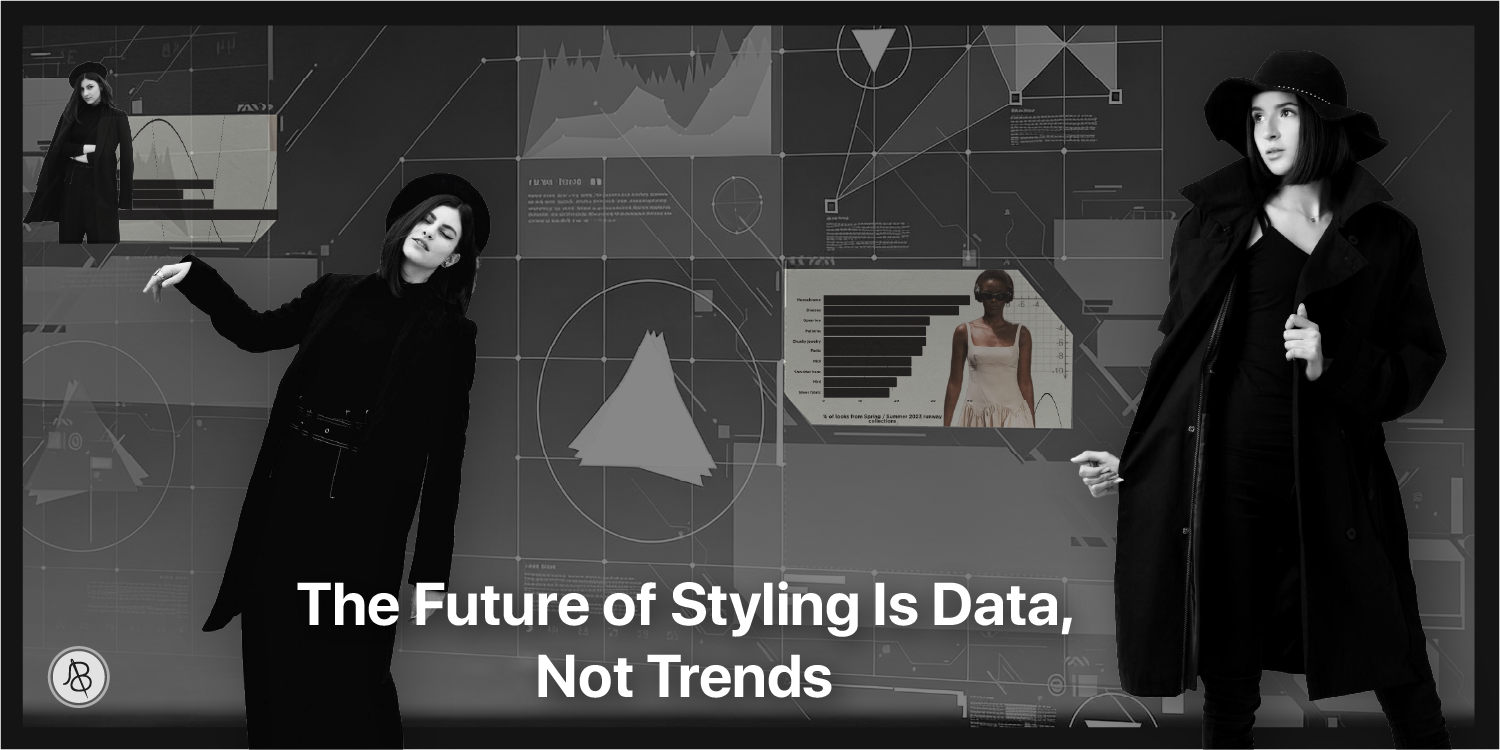
For decades, the fashion industry has operated on a top-down model. A select group of designers, editors, and forecasters decided what was "in," and the rest of the world scrambled to keep up. We waited for the September issues. We watched the runways. We let the cycle of trends dictate what hung in our closets. It was a system built on novelty, anxiety, and the perpetual feeling that what we owned yesterday wasn't good enough for today.
But the tectonic plates of the industry are shifting. We are entering a new era where the authority is moving from the runway to the individual. The future of styling is no longer about chasing the external noise of trends. It is about listening to the internal signal of data.
When we talk about data in fashion, it is easy to imagine cold spreadsheets, sales reports, or algorithms designed to sell you more stuff. But that is the old definition. In the context of modern styling, data is something far more intimate. It is behavior. It is the silent language of your daily choices. It is what you reach for when you're running late. It is the texture you gravitate toward when you need comfort. It is the silhouette that makes you stand taller in a meeting.
This behavioral data reveals truths about personal style that no trend forecast ever could. While trends operate at a mass level—telling us what "everyone" is wearing—data operates at an individual level, revealing what you actually wear. And in 2026, that distinction changes everything.
The Problem with the Trend Cycle
To understand why data is the future, we first have to look at why the trend cycle is failing us. For the last twenty years, the speed of fashion has accelerated to a breakneck pace. We went from two seasons a year to fifty-two micro-seasons. Social media turbo-charged this, turning trends into viral moments that burn out before most people even have a chance to participate.
This hyper-speed creates a disconnect. We buy things because they look good on a screen, or because an influencer wore them, or because we have a fear of missing out. But when these items arrive in our homes, they often fail the reality test. They don't fit our lifestyle. They don't match our existing wardrobe. They don't feel like "us."
The result is a closet full of clothes and nothing to wear—a phenomenon known as "wardrobe paralysis." It is the friction caused by a misalignment between what we think we should wear (trends) and what we actually need (reality).
Trends are, by definition, generalized. They are designed to appeal to the widest possible audience or to create a visual spectacle. They do not care that you commute by bike, or that you hate the feeling of polyester, or that you prefer structured shoulders. They are a broadcast signal. Styling, however, should be a conversation.
Redefining Data: The Behavior of Dressing
The shift toward data-driven styling changes the conversation from "What is new?" to "What works?" It treats the wearer not as a consumer to be sold to, but as a user to be understood.
Every time you get dressed, you generate data points.
This is behavioral data. It is the most accurate predictor of future satisfaction. If you consistently reach for high-waisted, wide-leg trousers made of natural fibers, that is a data pattern. It suggests that your next purchase should align with those parameters, regardless of whether skinny jeans are currently "trending" on TikTok.
When styling is based on this data, it becomes precise. It removes the guesswork. It stops being about aspiring to be someone else and starts being about refining who you are.
The Psychology of the "Uniform"
One of the most compelling arguments for data-driven styling is the concept of the personal uniform. Historically, fashion icons—from Steve Jobs to Carolyn Bessette-Kennedy—have been celebrated for having a signature look. They didn't chase trends; they found a formula that worked and stuck to it.
In the past, finding a uniform was a process of trial and error that could take decades. You had to buy a lot of mistakes to find the few successes. Today, data shortcuts that process.
By analyzing your wearing habits, we can identify the components of your uniform before you even realize them yourself. We can see that you prefer monochromatic palettes in winter but experiment with prints in summer. We can see that you prioritize movement and stretch on weekdays but embrace structure on weekends.
This insight allows for the creation of a "modular wardrobe"—a collection of clothes where every piece interacts seamlessly with the others because they all adhere to the same data-set of preferences. This is the ultimate goal of modern styling: a closet with zero friction.
Reducing Friction in Everyday Life
Let’s talk about that friction. Decision fatigue is real. The average person makes thousands of decisions a day, and the question "What should I wear?" is often one of the first. When your closet is built on trends, that question is stressful. You have to constantly recalibrate your image to match an external standard. You have to figure out how to style the "It item" of the month.
When your closet is built on data, the friction disappears. You open the door, and you see a reflection of your reality. You see clothes that fit your body, your routine, and your aesthetic values. Getting dressed becomes a reflex, not a puzzle.
This is where the concept of "Cost Per Wear" (CPW) becomes vital. In a trend-driven model, we often ignore CPW in favor of the initial thrill of purchase. In a data-driven model, CPW is a key metric of success. A $300 blazer that you wear 100 times is a smarter data decision than a $30 dress you wear once. Data helps us justify investing in quality because we have the evidence to prove we will use it.
Precision Over Novelty
We are moving into an era of precision. In every other aspect of our lives—from the music Spotify recommends to the routes Google Maps suggests—we expect personalization based on our history. Why should our clothes be any different?
The future of styling is predictive. Imagine a system that knows you have a wedding coming up in October. It knows you tend to run cold. It knows you prefer midi lengths over maxis. It knows you own a pair of silver heels you love but rarely wear. Instead of showing you the generic "Wedding Guest Edit" from a major retailer, it suggests a specific dress that ticks all your behavioral boxes and pairs perfectly with the shoes you already own.
This is precision styling. It is not about selling you a new identity. It is about optimizing the one you have.
This shift also has profound implications for sustainability. The most sustainable garment is the one you already own. The second most sustainable is the one you buy and actually wear. By using data to ensure alignment between purchase and preference, we drastically reduce the rate of returns and the volume of clothing that ends up in landfills. We stop buying for the fantasy life we think we should have and start dressing for the real life we are actually living.
The Role of BeSpoke AI Stylist
Navigating this shift from trends to data can be challenging. We have been conditioned for years to look outward for validation. We have been taught that if we don't follow the trend, we are "out of touch." Retraining our brains to look inward—to trust our own data—takes support.
This is where BeSpoke AI Stylist enters the narrative. We are not a shopping bot. We are not here to push the latest drop from a fast-fashion giant. We are an intelligence layer for your wardrobe.
BeSpoke AI Stylist functions as the analyst of your personal style. We process the signals you send through your clothing choices. We look at the textures you save, the silhouettes you repeat, and the items you ignore. We aggregate this behavioral data to build a comprehensive profile of your style DNA.
We don't just tell you what is cool. We tell you what is you.
The End of "In" and "Out"
As we embrace data, the binary concept of "in" and "out" begins to dissolve. If your data shows that skinny jeans are the most functional, comfortable, and confidence-boosting item for your lifestyle, then for you, they are "in." It does not matter what the runways of Paris say.
This is the liberation of the data era. It gives you permission to opt out of the cycle. It validates your personal taste as the highest authority. It creates a fashion landscape that is diverse, interesting, and authentic, because everyone is dressing according to their own internal logic rather than a singular external mandate.
In 2026, the question is no longer "Is this trendy?" The question is "Is this me?" And thanks to data, we finally have the answer.
The Future Is Quietly Confident
The aesthetic of the future is not loud. It is not screaming for attention with neon colors or exaggerated proportions unless those things are genuinely core to the wearer's identity. The aesthetic of the data-driven future is quiet confidence. It is the look of someone who knows exactly who they are.
It is a wardrobe where everything fits. Where everything is worn. Where getting dressed is a five-minute ritual of self-affirmation rather than a twenty-minute battle with insecurity.
We are moving away from the "fashion victim"—the person who wears clothes that wear them—and toward the "style architect"—the person who builds a look that serves them.
This evolution is inevitable. As our digital lives become more integrated with our physical ones, the feedback loop between behavior and choice will only tighten. Smart mirrors, digital wardrobes, and AI stylists are simply the tools that facilitate this conversation.
But the core shift is philosophical. It is a return to the idea that clothes are meant to serve life, not the other way around.
Conclusion: Your Data, Your Style
The next time you stand in front of your closet, look at the clothes you actually wear. Ignore the ones you wish you wore. Ignore the ones you bought because a magazine told you to. Look at the faithful basics, the worn-in favorites, the pieces that make you feel like yourself.
That is your data. That is the roadmap to your future style.
The industry will continue to churn out trends. They will continue to try to manufacture desire. But you don't have to participate in that economy of waste and anxiety. You can choose the economy of insight.
By embracing data, you reclaim control. You stop being a passive consumer of fashion and become the active curator of your own image. You build a wardrobe that is resilient, sustainable, and deeply, undeniably yours.
Fashion is changing. It is getting smarter, kinder, and more personal. The future of styling isn't about looking like everyone else. It's about looking like you—backed by the evidence to prove it.